On this page
The order of the visit
- Ground floor: Museo dell'Opera and courtyard.
- Loggia floor: the rooms of the magistracies (Censori, Avogaria, Scrigno, Milizia da Mar).
- Second floor: Atrio Quadrato, Quattro Porte, Anticollegio, Collegio, Senato, Consiglio dei Dieci, Bussola; from here, the Armoury.
- First floor, coming down from the Armoury: Liagò, Quarantia Civil Vecchia, Sala del Guariento, Maggior Consiglio, Scrutinio, Quadreria.
- Prigioni Nuove (New Prisons), across the Bridge of Sighs.
Museo dell'Opera
This is where the original capitals of the portico and the loggia are kept. From 1875 a major restoration replaced 42 fragile old capitals with copies; the restored originals are displayed in six rooms. Among them is the capital of the Trades; at the end of one room is the architrave of the Porta della Carta bearing the name of Bartolomeo Bon.
The courtyard and the loggias
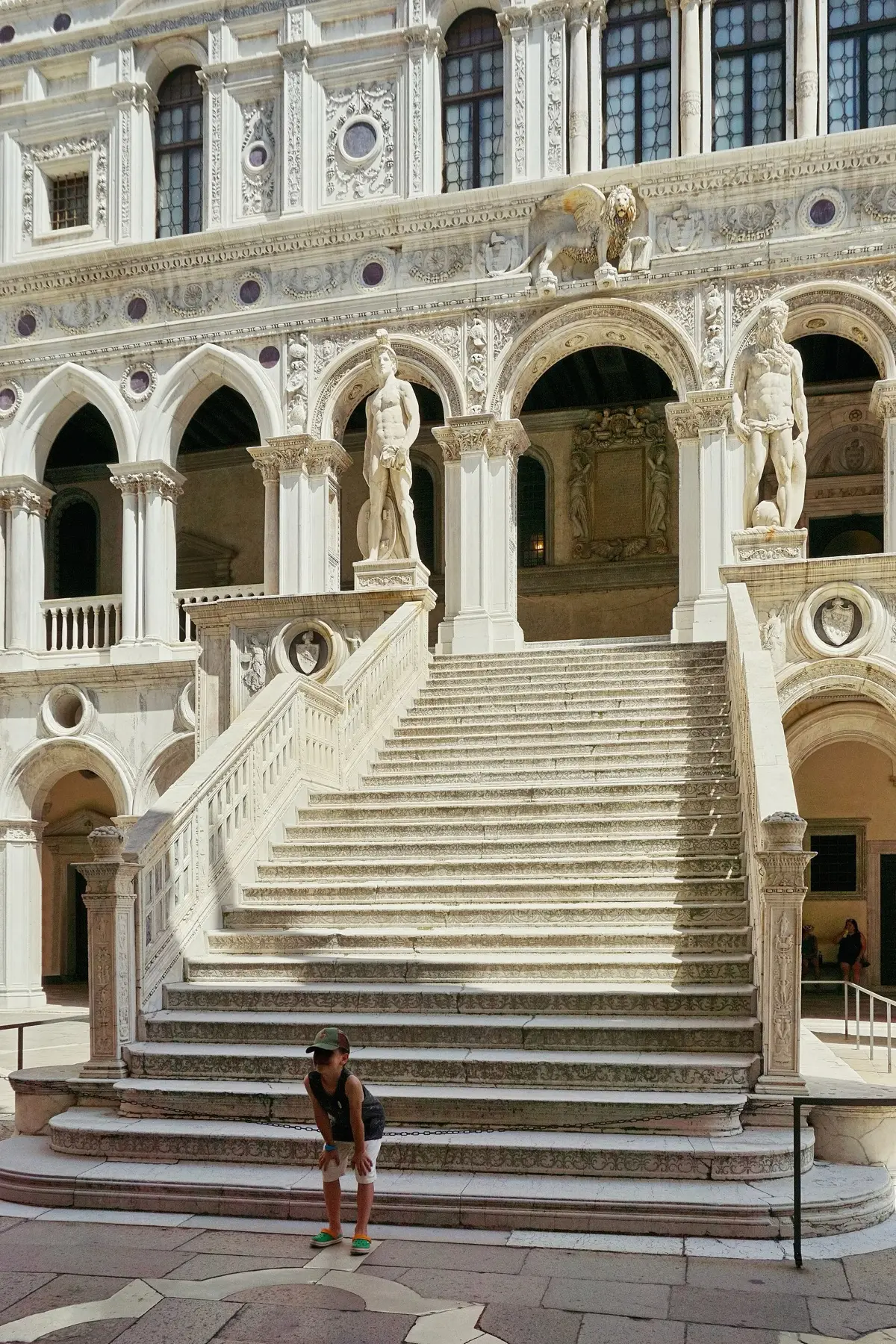
Coming in through the Porta del Frumento you are on the oldest side, to the south; on your left is the wing on the Piazzetta, on your right the Renaissance wing. At the far end stands Antonio Rizzo's Scala dei Giganti (Giants' Staircase), once the ceremonial entrance, with Sansovino's Mars and Neptune (1565), symbols of Venice's power on land and sea. On the opposite side is the Scala dei Censori (1525): this is where the climb begins today.
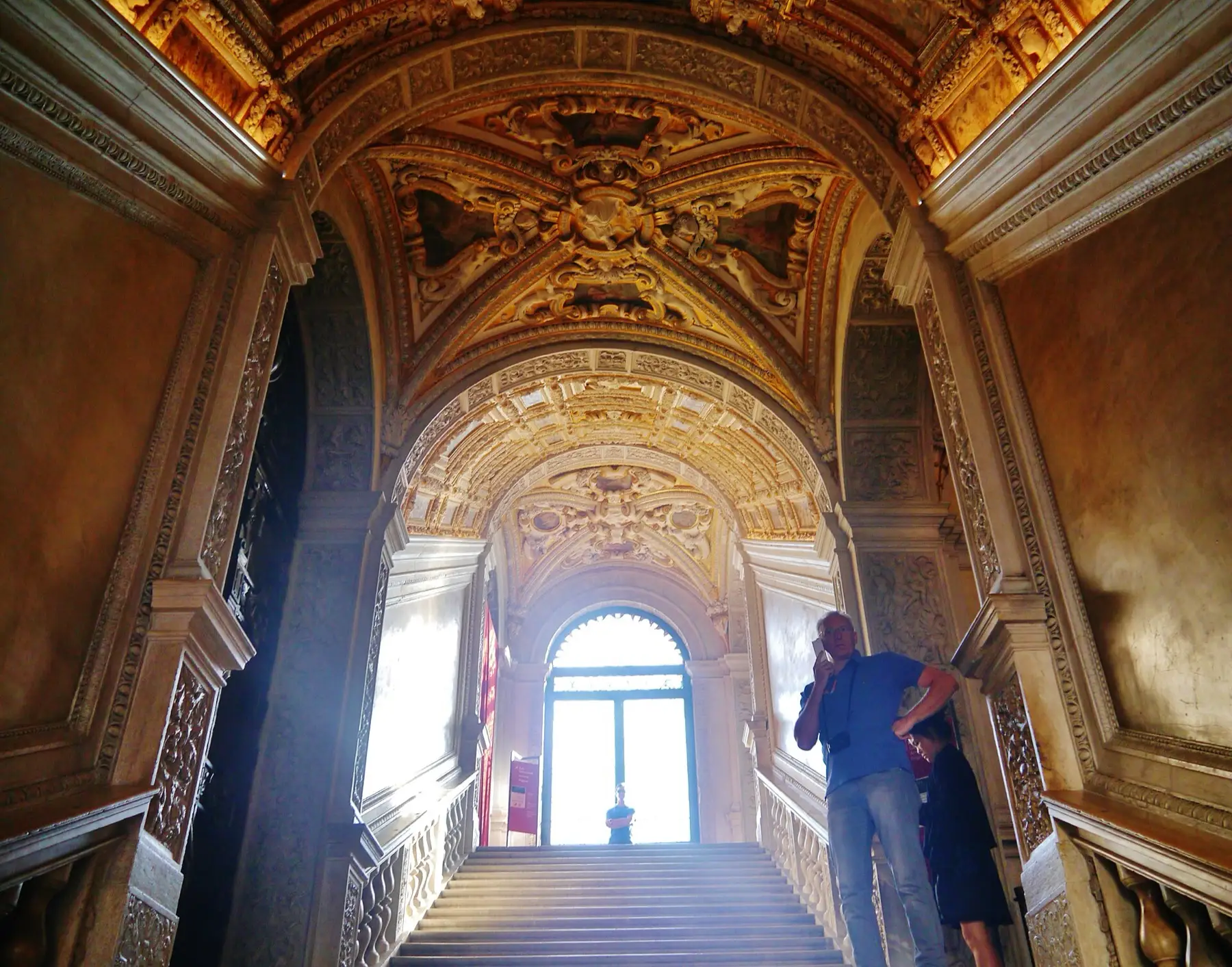
Along the loggias, in the wall of the Renaissance wing, you can see the lion's mouths: from the late 16th century people could slip reports of crimes or embezzlement into them. The way up the Scala d'Oro (Golden Staircase) is flanked by Tiziano Aspetti's groups of Atlas and Hercules.
The rooms on the loggia floor
- Sala dei Censori: a magistracy created in 1517, two censors with no power of judgement but with moral authority.
- Avogaria de Comun: three magistrates, with roots in the 12th century, guardians of the rule of law.
- Sala dello Scrigno: home of the Golden Book, recording the births of patricians, and the Silver Book.
- Milizia da Mar: the magistracy that recruited the crews of the fleet.
The second floor: government
- Atrio Quadrato (Square Atrium): the antechamber to the organs of government, with Doge Girolamo Priuli on the ceiling.
- Sala delle Quattro Porte (Room of the Four Doors): a passage with four doorways in Eastern marble; on the walls, among others, Titian's Doge Antonio Grimani.
- Anticollegio: the formal waiting room for ambassadors about to be received.
- Sala del Collegio: where the Savi and the Signoria met; decorated to a design by Palladio after the fire of 1574, with a ceiling by Paolo Veronese.
- Sala del Senato, known as the room “of the Pregadi” because the doge “begged” (pregava) its members to take part: economy, finance and foreign policy.
- Sala del Consiglio dei Dieci (Council of Ten): the council created to try the conspiracy of 1310, later a permanent body.
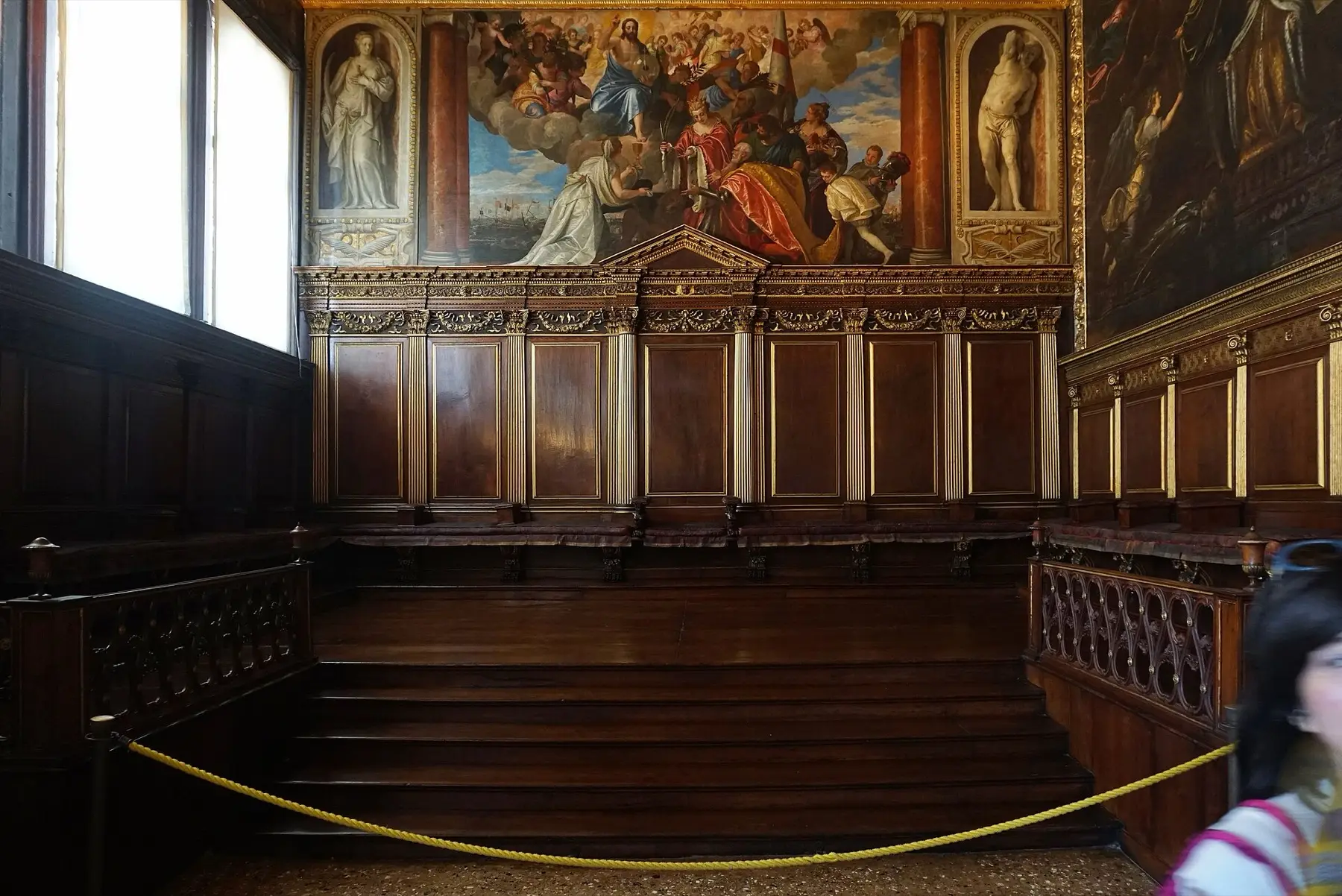
- Sala della Bussola: the waiting room for those summoned by the magistrate, with the great wooden screen (bussola) topped by Justice.
All the rooms of justice were connected vertically: from the Pozzi on the ground floor up to the rooms of the Heads of the Council of Ten and of the Inquisitors, which you can see today on the Secret Itineraries.
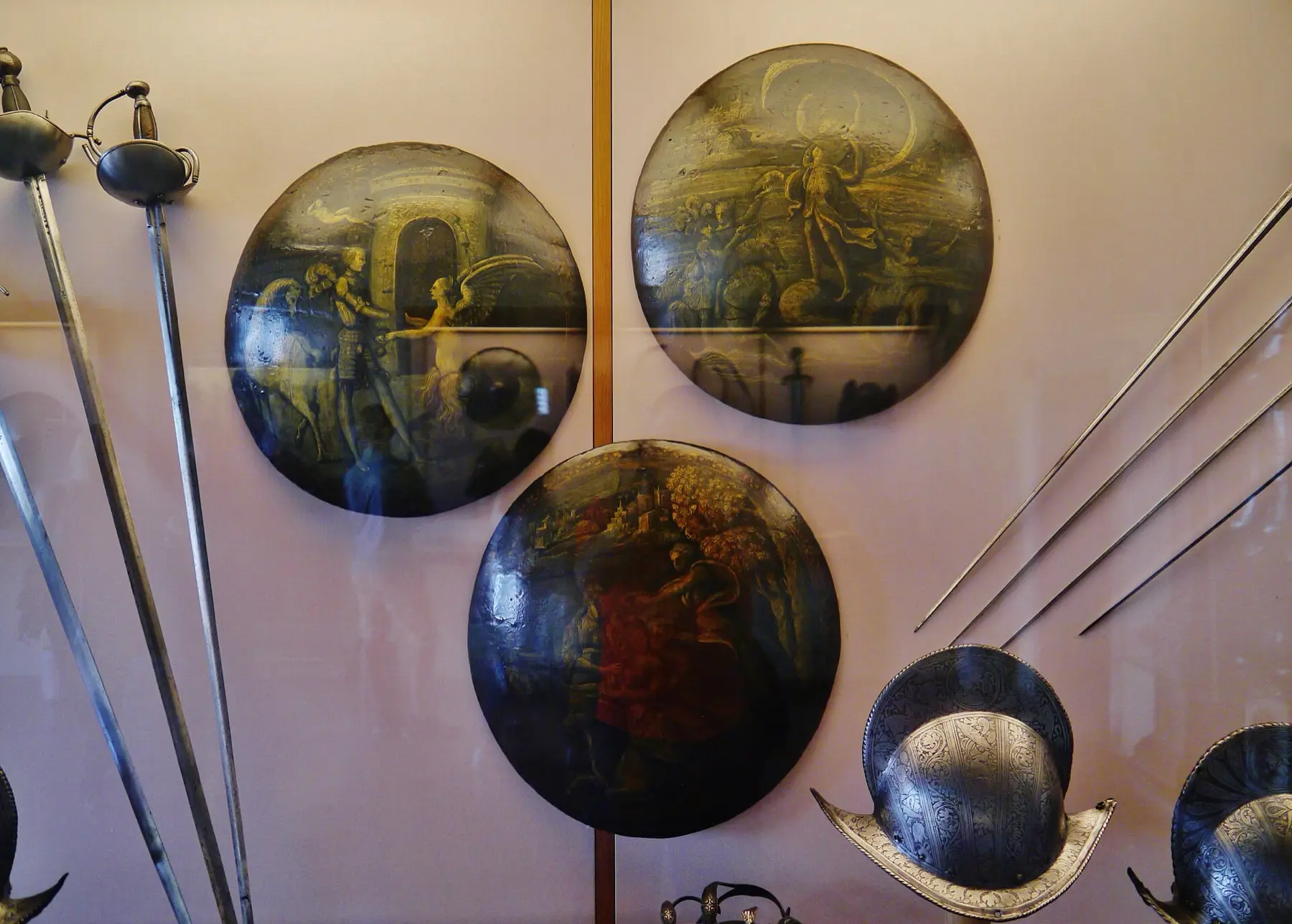
The Armoury
From the Bussola you pass into the Armoury, a collection documented since the 14th century under the control of the Council of Ten. In the first room, known as the Gattamelata room, is the armour attributed to the condottiere; there is also a child's (or a dwarf's?) suit of armour found on the battlefield of Marignano in 1515.
The first floor: the Great Council
- Liagò: the glazed veranda where patricians strolled during breaks in the Great Council; Antonio Rizzo's original statues are here.
- Quarantia Civil Vecchia: one of the three courts of appeal, for civil cases in Venice.
- Sala del Guariento: the remains of the fresco of the Coronation of the Virgin (1365–1368), painted for the Great Council and ruined by the fire of 1577.
Then the Sala del Maggior Consiglio (Chamber of the Great Council), 53 metres by 25: the assembly of all Venetian patricians met here, and this is where the election of the doge began. Below the ceiling runs the frieze with the portraits of the first 76 doges; behind the throne is the Paradise by Tintoretto and his workshop (1588–1592).
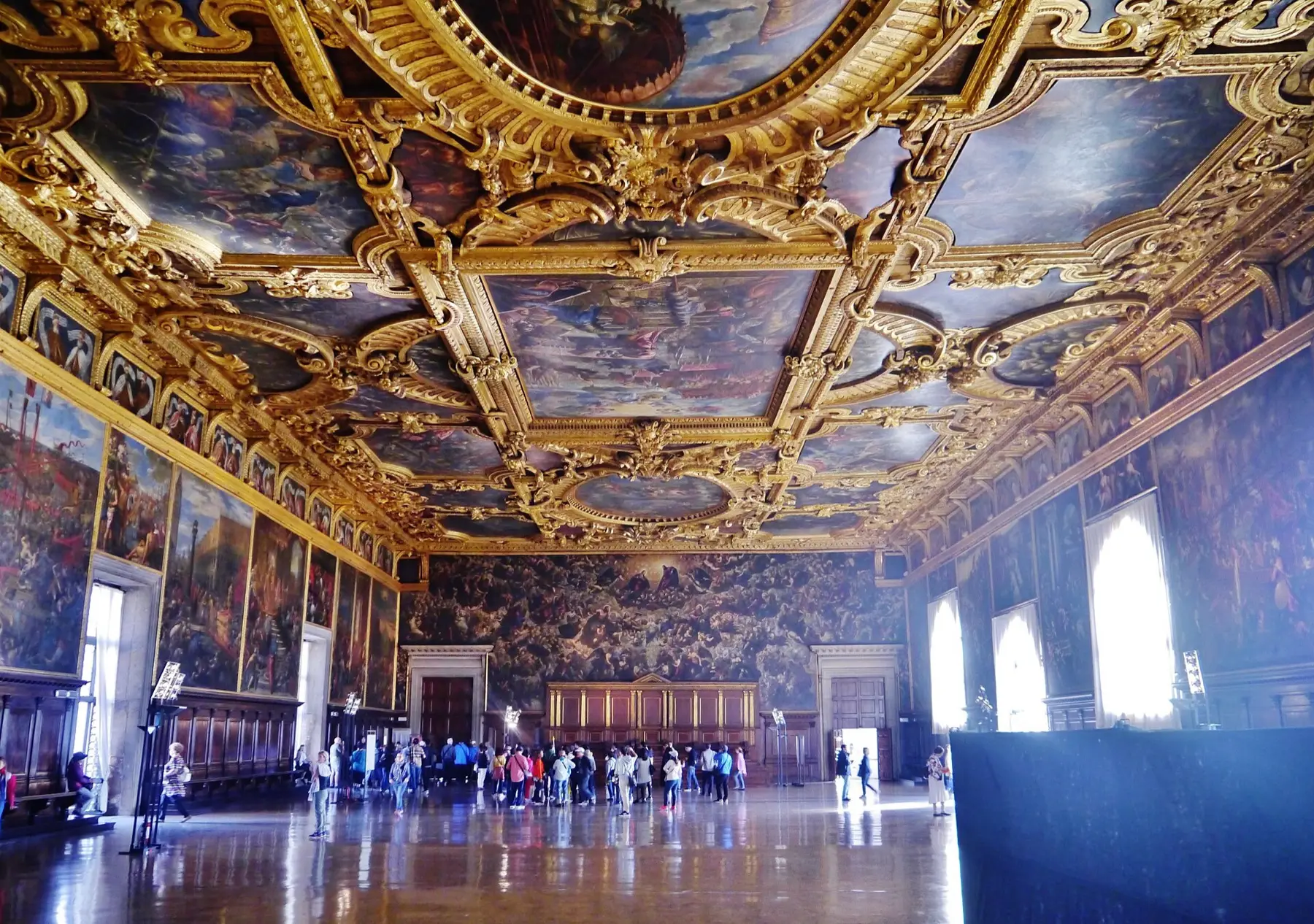
Next comes the Sala dello Scrutinio (Ballot Chamber), built in the 15th century for the manuscripts of Petrarch and Bessarion and used from 1532 for elections as well; on the walls hang Andrea Vicentino's Battle of Lepanto and Palma il Giovane's Last Judgement.
The Quadreria
The paintings of the Quadreria (picture gallery) hang in the rooms of the Quarantia Criminal, the Sala dei Cuoi and the Magistrato alle Leggi: Giovanni Bellini's Pietà (1472), Carpaccio's Lion of St Mark (1516), Tiepolo's Neptune and the Flemish panels. Details on the masterpieces page.
Bridge of Sighs and Prigioni Nuove
From the Sala del Magistrato alle Leggi a narrow staircase leads to the Bridge of Sighs and the Prigioni Nuove, where every cell was lined with larch boards. All the details on the prisons page.
Visiting with a guide or an audio guide
- Doge's Palace with a guide Tiqets · The palace route with a guide · ★ 4.3/5 (504)from €64
- Doge's Palace with audio guide, prisons and Correr GetYourGuide · Entry with audio guide, Correr Museum included · ★ 4.3/5 (501)from €40.50
- Secret Itineraries with a guide Tiqets · Guided tour off the main route, plus the four museums · ★ 4.5/5 (616)from €40
Partner prices checked on 27 October 2026; you see the total before you pay.
What about the Doge's Apartment?
The doge's rooms, in the wing between the Rio della Canonica, the Scala d'Oro and the apse of the basilica, now host a changing programme of temporary exhibitions. They include the Sala dello Scudo, where the coat of arms of Ludovico Manin, the last doge, is displayed, and the Sala degli Stucchi with a portrait of Henry III of France.
Questions and answers
What is there to see in the Doge's Palace?
The courtyard with the Scala dei Giganti, the second-floor rooms (Collegio, Senato, Consiglio dei Dieci), the Armoury, the Sala del Maggior Consiglio with Tintoretto's Paradise, the Quadreria and the prisons across the Bridge of Sighs.
In what order do you visit the rooms?
Ground floor and loggias, then the second floor and the Armoury, then down to the first floor (Maggior Consiglio, Scrutinio, Quadreria), finishing in the prisons.
Can you visit the Doge's Apartment?
Its rooms host a changing programme of temporary exhibitions; check the official website to see what's on during your visit.
How long does the visit take?
The official website gives no length for a self-guided visit.
Where our information comes from
- Doge's Palace: the state rooms (in Italian) — checked on 27 October 2026
- Doge's Palace: second floor (in Italian) — checked on 27 October 2026
- Doge's Palace: first floor (in Italian) — checked on 27 October 2026
- Doge's Palace: loggia floor (in Italian) — checked on 27 October 2026
- Doge's Palace: the courtyard and loggias (in Italian) — checked on 27 October 2026
- Doge's Palace: the Museo dell'Opera (in Italian) — checked on 27 October 2026
- Doge's Palace: the Armoury (in Italian) — checked on 27 October 2026
- Official guide to the Doge's Palace (PDF, in Italian) — checked on 27 October 2026