Everything you need to visit the heart of the Serenissima without surprises: updated prices, opening hours, priority entry, Secret Itineraries and combo with St Mark's Basilica.
⚠ Not official — infoSelection of experiences at Doge's Palace: simple entry, skip the line, guided tours and combinations with other monuments in St Mark's Square.
Reference data from the official site palazzoducale.visitmuve.it. Rates and hours may vary; always verify availability before visiting.
Doge's Palace is not just a palace. For over a thousand years it was the political, judicial and symbolic center of the Venetian Republic: residence of the Doge, seat of the Great Council, courthouse, State prison. Walking inside means crossing the machinery of power that held up a thalassocracy capable of controlling the Eastern Mediterranean from the 13th to the 18th century.
The current building, in Venetian Gothic style with arcaded loggias and cladding of white and pink marble from Verona, is the result of three main construction phases (14th-16th centuries) and post-fire interventions. The facade overlooking the wharf, with the Porta della Carta at the foot of St Mark's Campanile, is one of the manifestos of European florid Gothic.
If it's your first time in Venice and you have only one morning, spend at least 2 full hours at Doge's Palace. Below this threshold you'll miss the halls that really justify the ticket price: the Great Council, the Hall of Scrutiny and crossing the Bridge of Sighs. If possible, add the Secret Itineraries — the guided tour that takes you to interrogation rooms, the Leads prison and the Inquisition Hall: this is the part of the palace most tourists will never see.
Full price, reduced, free admission, audioguide, Secret Itineraries, MUVE Friend Card. What's really worth buying and what's not.
Read the guide →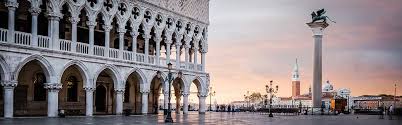
Summer and winter hours, extended evening hours, last entry, closure days, low-traffic time windows.
View hours →
Combined St Mark's Basilica + Doge's Palace ticket: what's included, how much you save, when it's worth it.
Compare →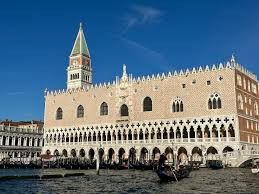
How fast-track really works, what priority entry means, when you really need it, free alternatives.
Save time →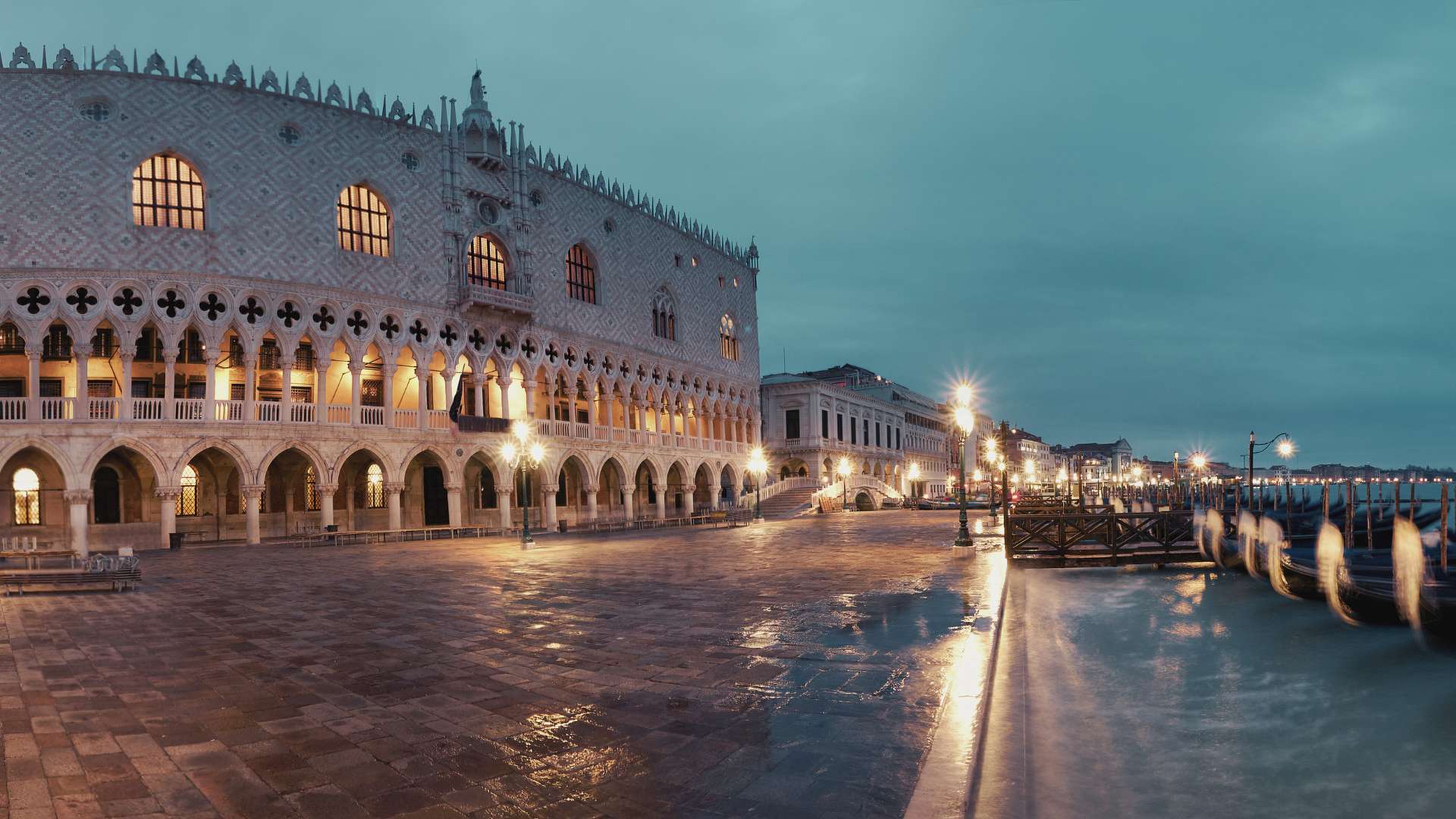
Who runs this guide, why it exists, how we're funded and our editorial policy.
Learn more →The first ducal residence was built around 810, when the lagoon government moved from Malamocco to the Rialto islands. It was a fortified structure with corner towers: it served to defend the Doge from the Frankish fleet and internal factions. Almost nothing remains of that first nucleus — subsequent fires (976, 1106) erased its traces.
The palace we see today was born in 1340. The Great Council commissioned the construction of a new hall capable of hosting its members — already over a thousand — above the arcade overlooking the lagoon. It's the block along the wharf, recognizable by the sequence of pointed arches and the two-tone marble cladding. Between 1424 and 1442 the wing overlooking the Square was added, in stylistic continuity. The Porta della Carta, a masterpiece by Bartolomeo and Giovanni Bon, closed the corner toward the Basilica in 1442.
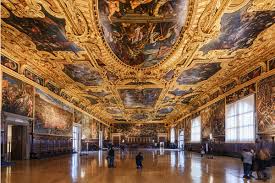
Two fires in the 16th century (1574 and 1577) destroyed entire fresco cycles. The Republic decided not to rebuild in the old style, but to fill the walls with the generation of painters working in the city: Veronese, Tintoretto, Palma the Younger, Jacopo Bassano. It's in this phase that the decoration is born that dominates the visiting experience today. The Paradise by Jacopo and Domenico Tintoretto, on the back wall of the Great Council Hall, is one of the largest canvas paintings ever created: over 22 meters wide.
With the fall of the Republic in 1797, the building lost its political function but not its symbolic meaning. It became an Austrian administrative seat, then Italian. In 1923 it was entrusted as a museum. Since 1996 it has been managed by the Civic Museums Foundation of Venice (MUVE), which today oversees its collections, restorations and ticketing.
The Secret Itineraries are a guided tour with limited numbers that opens normally off-limits rooms: the Ducal Chancellery, the Torture Hall, the Leads cells under the roof (from which Casanova escaped in 1756) and the Wells. This is a route that reconstructs not the ceremonial aspect of the palace, but the operational one: where decrees were written, where records were stored, where defendants were interrogated.
Duration is about 75 minutes. Groups are limited (usually 20-25 people). Tours are offered in Italian, English and French, with fixed times throughout the day. They cost extra compared to standard tickets. If you're passionate about history or ante-litteram true-crime tours, this is the add-on that's worth it. If traveling with children under 10, consider: the spaces are tight, some passages are sloped, the duration is demanding.
The public entrance is in St Mark's Square, from the Porta del Frumento on the basin side. You can reach it on foot from anywhere in the historic center in 10-25 minutes. By vaporetto, useful stops are San Zaccaria (lines 1, 2, 4.1, 4.2, 5.1, 5.2) and Vallaresso – San Marco (lines 1, 2). From Piazzale Roma or Santa Lucia station, line 1 takes 35-45 minutes, line 2 takes 25-30 minutes.
If arriving from Marco Polo Airport, the quickest option is Alilaguna Blue Line to San Marco. Water taxi from the airport dock to the palace takes 30-35 minutes. From Mestre, trains every 10 minutes to Santa Lucia, then vaporetto.
There are few places in Venice with a greater difference between high and low season. In July-August and weekends in April-May, queues in the Square easily reach 60-90 minutes for those without reservations. In November or February, on a weekday, you can enter in 5 minutes.
 Doge's Palace